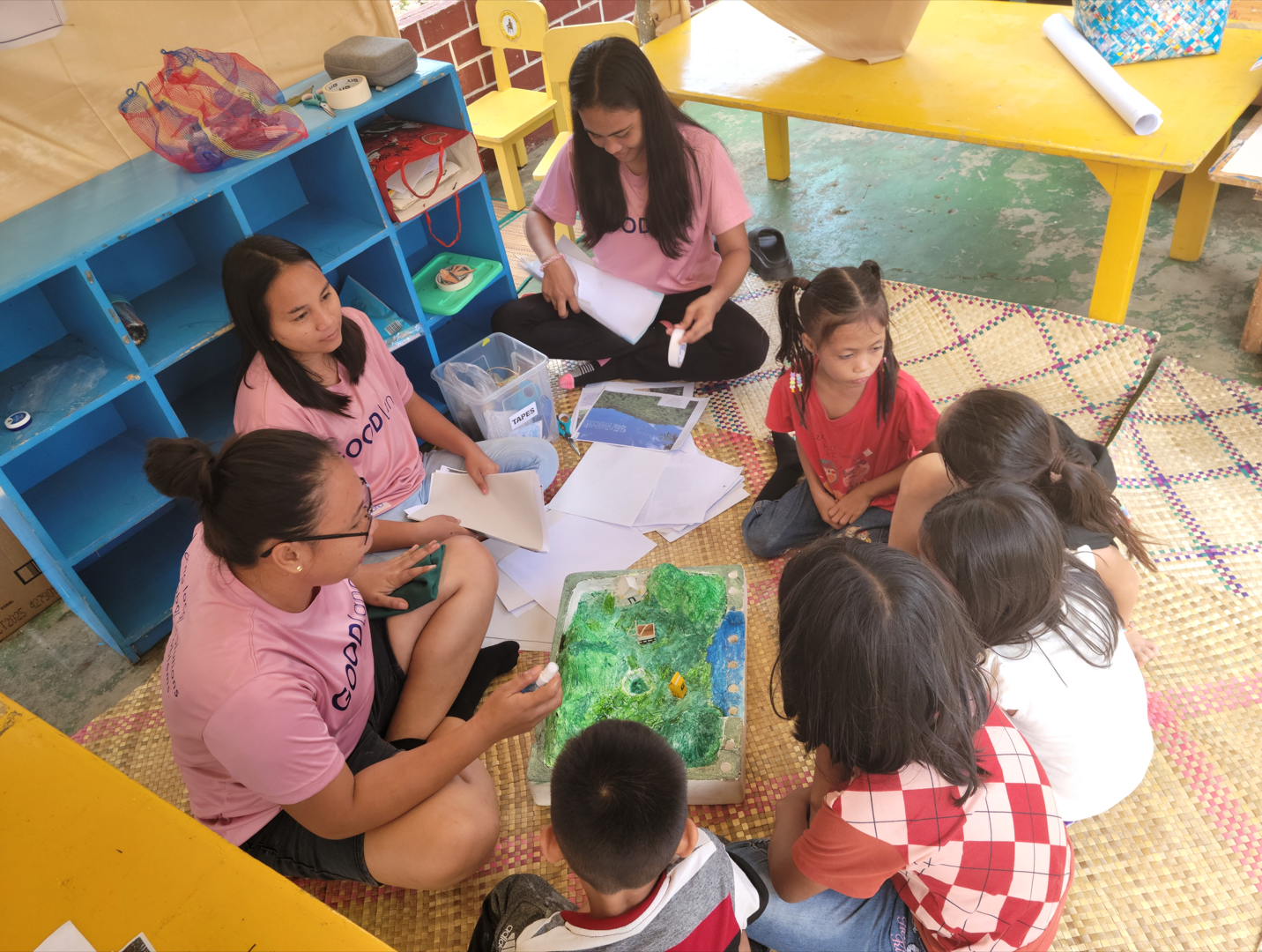
Who We Are
GOODLand is a Living Archive and collaborative platform within Martha Atienza’s ArtLab. Based on Bantayan Island in the Philippines, it explores how art can function as a methodology for addressing environmental, social, and economic challenges through observation, experimentation, and collective learning.
Working alongside farmers, fisherfolk, youth, local government, and other partners, GOODLand develops community-led initiatives that connect ecological restoration, local knowledge, food and water security, and cultural heritage. These activities form part of an evolving Living Archive, where documentation, dialogue, and action become tools for understanding and responding to change.
Through projects both on the ground and online, GOODLand seeks to create sharable models that strengthen community resilience while contributing to broader conversations on ecology, culture, and the future of island communities.
The Coconut Tree Methodology
The Coconut Tree Methodology is an artistic and collaborative framework developed by Martha Atienza through her ArtLab and practiced through GOODLand. Rooted in Bantayan Island, Philippines, it explores how art can function as a methodology for understanding, reflecting upon, and responding to environmental, social, economic, and cultural change.
Inspired by the structure of the coconut tree itself, the methodology understands knowledge as a living system. Like a tree, it grows from deep roots, passes through a process of transformation, and branches into many forms of action.
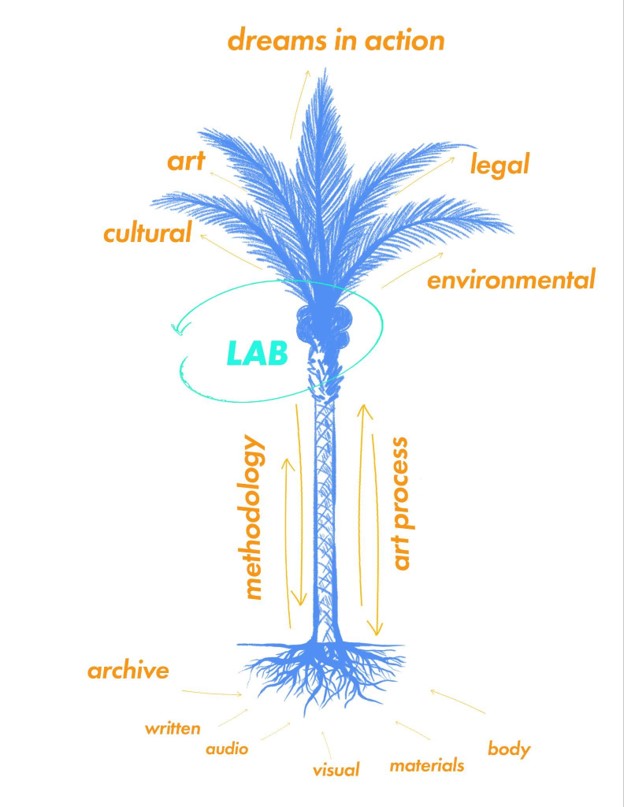
The roots form the Living Archive.
This archive is not limited to documents or records. It consists of stories, oral histories, observations, audiovisual materials, written accounts, local practices, biodiversity, memories, and lived experiences gathered over time.
The Living Archive is created collectively by community members, collaborators, artists, researchers, and participants. It continues to grow as new knowledge is shared and new experiences emerge.
The roots ground the methodology in place while preserving relationships between people, culture, land, water, and history.
The archive is not simply a collection of information. It is a repository of knowledge, memory, and experience that allows people to understand where they come from.
The trunk is where the Living Archive is activated.
Stories, observations, documentation, local knowledge, and lived experiences gathered within the archive are brought together, shared, discussed, and reflected upon. Through this process, participants encounter themselves and their communities in new ways. They see their own knowledge, histories, practices, and relationships made visible.
This moment of recognition is central to the methodology. When people see themselves reflected through documentation, dialogue, and collective learning, they gain a deeper understanding of who they are, what knowledge they hold, what has changed, and what possibilities exist moving forward.
The methodology does not seek a single interpretation or outcome. Each person draws their own insights and conclusions from the archive.
For some, this may lead to seed saving, farming practices, watershed protection, environmental stewardship, or community initiatives. For others, it may lead to artistic works, research, legal strategies, educational programs, or new forms of collaboration.
The trunk is therefore the space of reflection, translation, and decision-making. It is where knowledge becomes agency and where an understanding of the past helps shape decisions about the future.
If we do not know where we come from, how can we know where we are going?
The ArtLab
Surrounding the trunk is the laboratory.
The laboratory is not a fixed place. It can be a community garden, a seed library, a rainwater catchment system, a workshop, a meeting, a film, an exhibition, a classroom, or a conversation.
It is where ideas are tested through experimentation and practice.
The goal is not to arrive at predetermined solutions. Instead, the methodology embraces uncertainty, curiosity, observation, and learning. Experiments may succeed, fail, evolve, or generate entirely new questions.
The laboratory creates the conditions through which knowledge can be transformed into action.
The Branches: Dreams in Action
From these experiments emerge many forms of action.
Artistic.
Cultural.
Environmental.
Legal.
Educational.
Social.
These are not separate disciplines but interconnected responses that grow from the same foundation.
Each branch represents a different expression of the knowledge gathered within the archive and interpreted through the trunk.
The community may establish seed-saving initiatives, restore ecosystems, strengthen local governance, or develop new farming practices.
Artists may create films, installations, performances, or exhibitions.
Researchers may produce studies. Educators may develop learning programs. Legal advocates may explore new protections for land, water, and culture.
The same archive can generate many different outcomes.
Why a Coconut Tree?
The coconut tree is deeply embedded in island life.
Every part of the tree serves a purpose. Its roots anchor it to place. Its trunk carries knowledge upward. Its fronds extend outward in many directions.
Like the communities that care for it, the coconut tree survives through adaptation, interconnectedness, and continual regeneration.
The Coconut Tree Methodology proposes that art is not only a way of representing the world. It is a way of observing, remembering, learning, imagining, and acting together.
The archive helps us understand where we come from.
The trunk helps us decide where we want to go.
The branches become the many futures we create together.